
One of the oldest spiritual tools used by humans for ages is the Mantra. There is not just one mantra but several mantras holding a unique spiritual power and benefit. When written scriptures were not so popular, the spiritual gurus used to pass on their mantras orally to the disciples. This used to be more like some spiritual legacy. Like this, the spiritual wisdom was protected for years.
Even in yoga, meditation, and practices like pranayama, mantras play a very important role. Even the most ancient Indian science of healing, Ayurveda, uses mantra as a part of its healing culture. Mantras are not just about reciting a queue of words but also the carriers of spiritual power and healing energies.
Talking about Mantras and Meanings, the word mantra is a Sanskrit term made up of two different words:
Man - Mind and Tra - Instrument or Tool.
Therefore, you can understand the mantra as a “Tool made for Mind”!
Mantra can be in the form of just a word, a syllable, or even a long phrase.
Mantra helps in connecting with our spiritual self, gaining consciousness and awareness and understanding the deepest dimensions of our life as a soul!
In this blog, we will explore the ancient secret of Vedic Traditions that are virtuous enough to transform your mind, soul, and physical self! Read till the end to uncover the unknown facts about mantras and their power!
To understand the mantra, you have to turn the thousands-of-years-old pages of Vedic India. Yes, this is the origin of Sanskrit mantras! The Rig Veda, which dates back to 1500 and 1200 BC, is the oldest sacred text in India and contains mantras. Not only this, but every holy book of India offers mantras as a secret power to activate the vibrational energies among humans and transform their lives positively!
If we talk about the Vedic traditions of India, mantras are considered as the sacred sounds which were not invented by human beings, but already present as the vibrations of the higher self or the universe. The profound sages or rishis of India, while performing, while reaching the highest states of meditation, are believed to have heard these mantras. This is the reason why the Vedic education is also known as Shruti. Shruti means something that is heard.
These sacred sounds were always preserved! The disciples and devotees since then have been chanting mantras through correct pronunciation, tones, and rhythms. It is said that even a slight change in the pronunciation can affect the energy of the mantras.
As time passed, even today, mantras are practised as the Vedic ritual of ancient India. Today, this Vedic ritual is helping in healing humans mentally, spiritually, emotionally, and physically!!
Today, mantras are also used in the following traditions:
Yoga and meditation
Tantras
Buddhism
Sikhism
Jainism
Devotional practices
Holistic healing traditions
Mindfulness
Sound healing, etc.
Almost every tradition following spirituality knows and practices the transformative energy of sound. The most common way to do that, since ancient times, has been chanting mantras!
As per the yogic philosophy, even the smallest creation in the universe occurred through a sound vibration. Before anything was formed on the earth, there was just a sound and its frequencies. Even the Sanskrit philosophies like Nada Brahma explain that even the universe has sound.
According to Vedic science, every living thing and every form of creation resonates at a certain vibration. Mantras are the sacred sound arrangements that help in maintaining that vibration for a healthy living and consciousness. This is the reason why various Vedic traditions and civilisations used hymns, chants, sacred recitations, prayers, etc., as their culture.
The purpose was not just worship, but something more than that: HOLISTIC TRANSFORMATION.
From the viewpoint of yoga, Traditional yogic practices are more than just some movement. Yoga is designed to harmonise body, mind, soul, and breath.
Mantras help yoga to ensure the following:
Better focus
Fewer mental distractions
Utmost level of meditation
Feeling of devotion
Inner awareness
Inner strength
Confidence
Good breath and consciousness sync!
Research suggests that mantra-based meditation may help reduce stress, anxiety, and symptoms of depression [Source: PubMed Study on Mantra-Based Meditation]
Mantras were never limited to spiritual dimensions! Even modern researchers came up with an interesting fact about mantras.
So, when we chant any mantra, we repeat that particular mantra several times. The very holy number is 108. When a mantra is repeated in a rhythm, it starts bringing a certain kind of repetitive resonance and a frequency of sound is produced. This sound interacts with our physical, mental and spiritual self and increases our vibration.
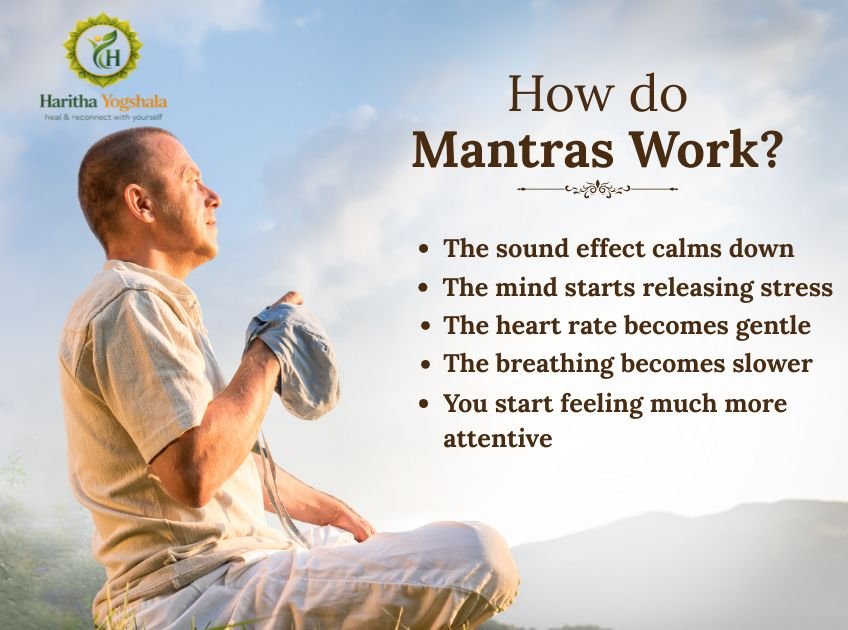
The sound effect calms down
It starts calming down the nervous system
The breathing becomes slower
The heart rate becomes gentle
The mind starts releasing stress
The mental state starts feeling less cluttered
You start feeling much more attentive
The suppressed emotions start releasing
The reactivity gradually decreases, and one starts feeling at peace and rejuvenated!
This is the power of chanting a mantra! Mantra holds the power to shift the brainwaves and create a state of relaxation. This is a beautiful combination of ancient wisdom and the modern benefits of chanting mantras. This is why, today, every holistic practice integrates mantra. So mantras are not just spiritual but are also healthy for humans!!
Also Read: [Sound Healing Therapy for Stress and Anxiety]
The scriptures and yogic traditions mention different ways to chant mantras:
In spiritual or devotional culture, mantras can be chanted using a rosary or beaded garland; one round makes 108 chants!
Mantras can be chanted while doing yoga!
You can chant a mantra during meditation
You can sync mantra with pranayama
Mantra chanting can also be done during sound healing practices!
Find a quiet place like a terrace, a prayer room, a natural setting, or your healing class
Roll out your mat or Asana
As directed by your Guru, be it a spiritual guru, yoga guru, or any healer guru, chant the mantra!
In India, there is also a tradition of Diksha, where Spiritual gurus secretly give you a word or Naam with directions on how to chant it! This is called Naam Jap! This also holds the scientific benefits of repetitive sound vibrations along with spiritual importance!
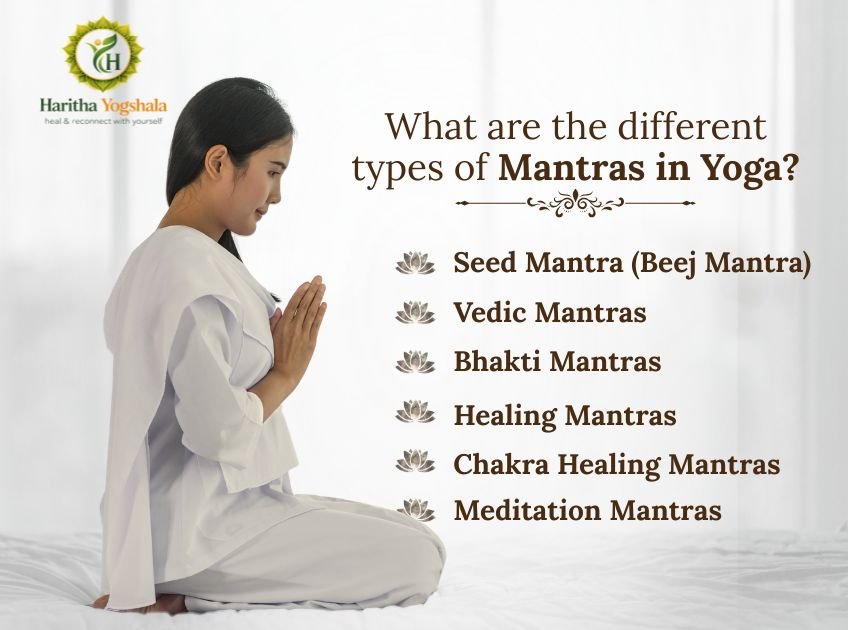
In yogic science, there are diversified types of mantras. Every mantra has a specific purpose. Some mantras are used for self-realisation; others are best for energy protection, activation, and healing. Here, we will understand the different types of mantras.
These different mantras are chosen by the yogis depending on the healing and spiritual goals of the particular yoga practice.
Seed mantras are also known as Beej Mantra. These mantras are sounds of a single syllable. Beej mantras are considered to be the concentrated form of various spiritual energies. These mantras are often used during chakra healing or during different energy work within the body.
Instead of a literal translation, the healing virtue of the Beej mantra lies in its small vibration.
Some of the common single-syllable Beej mantras are:
Hum
Lam
Vam
Ram
Yam
Om
These mantras are very common in yogic, spiritual and devotional practices even today. These are used for meditation, chakra balancing, and other healing practices, such as sound healing.
Another form of mantra is the Vedic mantra. These are the mantras mentioned in the Vedic scriptures of India. These mantras are not just used in India but are also famous worldwide for their amazing benefits. These traditional Vedic mantras require clear pronunciation and rhythm to benefit from their spiritual power.
These Vedic mantras used in yoga include the following:
Gayatri mantra
Mahamritunjaya Jap
Purusha Suktam Mantra Jap
These mantras are used for inner cleansing, purification, energy protection, energy balance and blessings from the divine.
Bhakti means devotion. This is why Bhakti mantras are used to express surrender, love, and devotion towards the divinity or deity. These are often used in yogic tradition during kirtan, prayer or various traditional yoga practices.
These devotional mantras include the japa of:
Om Namah Shivay
Om Namo Narayana
Hare Ram, Hare Ram, Hare Krishna, Hare Krishna,
These mantras have been used since ancient times to cultivate the feeling of devotion and surrender towards the divinity and prakriti, nature.
Now, another type of mantra is a healing mantra. These mantras are used to heal our physical, emotional, spiritual, and mental wellness and mental health. These mantras are also used in Ayurveda practices, sound healing practices, yoga, meditation, and pranayama.
Some of the examples of healing mantras are:
Mahamrityunjaya Mantra Japa
Dhanvantari Mantra Japa
Tandara Mantra Japa
Practitioners often use these mantras for quick recovery, inner strength, inner balance, and resilience.
Chakras are the seven centres present in the human body. Every chakra holds a specific energy that is responsible for our body's functioning. There are various mantras related to each chakra. These mantras help in activating and balancing the energies of the chakras or the energy centres.
For the root chakra, Lam.
Sacral chakra, Vam.
Solar plexus chakra, Ram.
Heart chakra, Yam.
Throat chakra, Ham.
Third eye chakra, Om |(AUM)
These mantras are also used while practising yoga, healing, pranayama, and meditation associated with chakra healing practices.
There are several mantras that can be repeated silently while sitting in the state of meditation. This helps in attaining the utmost level of meditation. Meditation at this level helps improve mental capacity, mental ability, the nervous system, and also fosters a good personality.
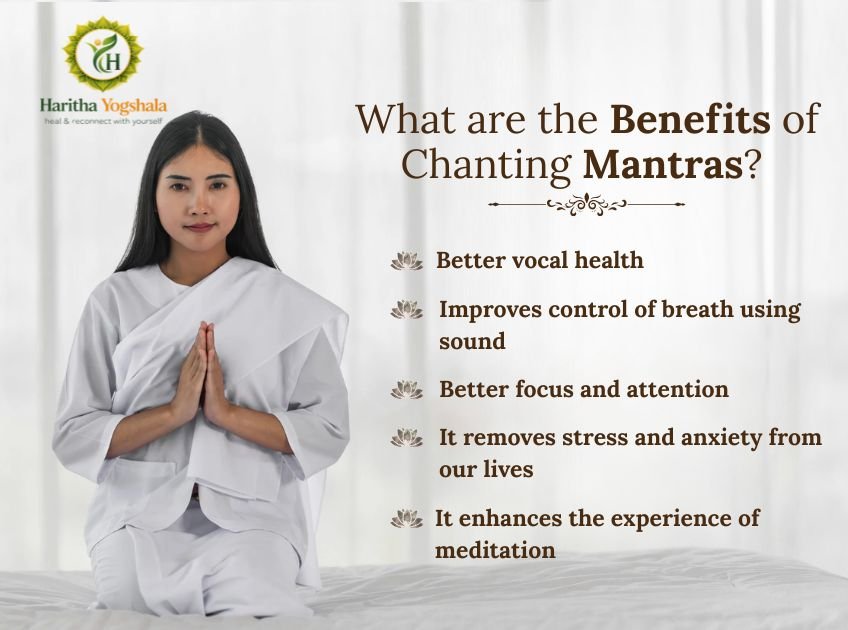
Mantra chanting in the yogic tradition has been benefiting the human race in multiple ways. Here, we will understand the different benefits that mantra chanting offers to us.
The repetitive rhythm of mantras helps the physical body in the following ways:
It helps improve the functioning of the lungs through repetitive and synchronised breathing
It helps reduce tension and stress from the physical body
Chanting mantras enhances the relaxation response of the body
Better vocal health
Improves control of breath using sound
Improves sense of energy and strength
Promotes good sleep quality and quick recovery from any kind of illness
Mantra chanting helps in quieting the mind and improving its power. Mental benefits include the following:
Better focus and attention
Enhanced level of concentration
Good mental clarity
Reduction in distractions and mental clutter
Mindfullness
Ability to stay in the present
Great mental strength
Great memory power
When we practice mantra regularly, we become less reactive, and discipline makes a firm place in our lives.
Mantra chanting also helps us psychologically and emotionally in the following ways:
It removes stress and anxiety from our lives
It helps in recovering from depression
It helps in releasing suppressed emotions
It makes us emotionally intelligent and strong
It offers positivity and optimism
It ensures a feeling of peace
It gives a sense of contentment with whatever we are blessed with in this life!
It helps in gaining self-awareness
It ensures self-awakening
It offers inner harmony
In yoga, mantra chanting also benefits us spiritually:
It enhances the experience of meditation
It cultivates faith and devotion in whatever holistic we do
It helps in being spiritually aware
It purifies our thinking
It makes our intentions positive and good
It helps with inner wisdom
It ensures inner realisation
It also offers personal transformation
It teaches righteousness
In some traditions, like Indian, it serves as a reminder of karma and Dharma!
Also Read: [ Benefits of Sound Healing Therapy]
Mantra chanting is not just spiritual or limited to one tradition, but it is a practice that is multidimensional in nature. Mantra chanting works on the scientific healing system of sound. The vibrations produced while chanting mantras benefit humans spiritually, energetically, emotionally, mentally, and even physically.
In today's modern wellness tradition, mantra chanting is integrated with various holistic practices like yoga, meditation, sound healing, pranayama, etc., to enhance the benefits of these practices. Mantra chanting is one of the most powerful tools used since ancient times to energise humans using sound vibrations.
Whether chanted for devotion purposes or for self-healing, mantra chanting has always helped humans as the most accessible tool of transformation!